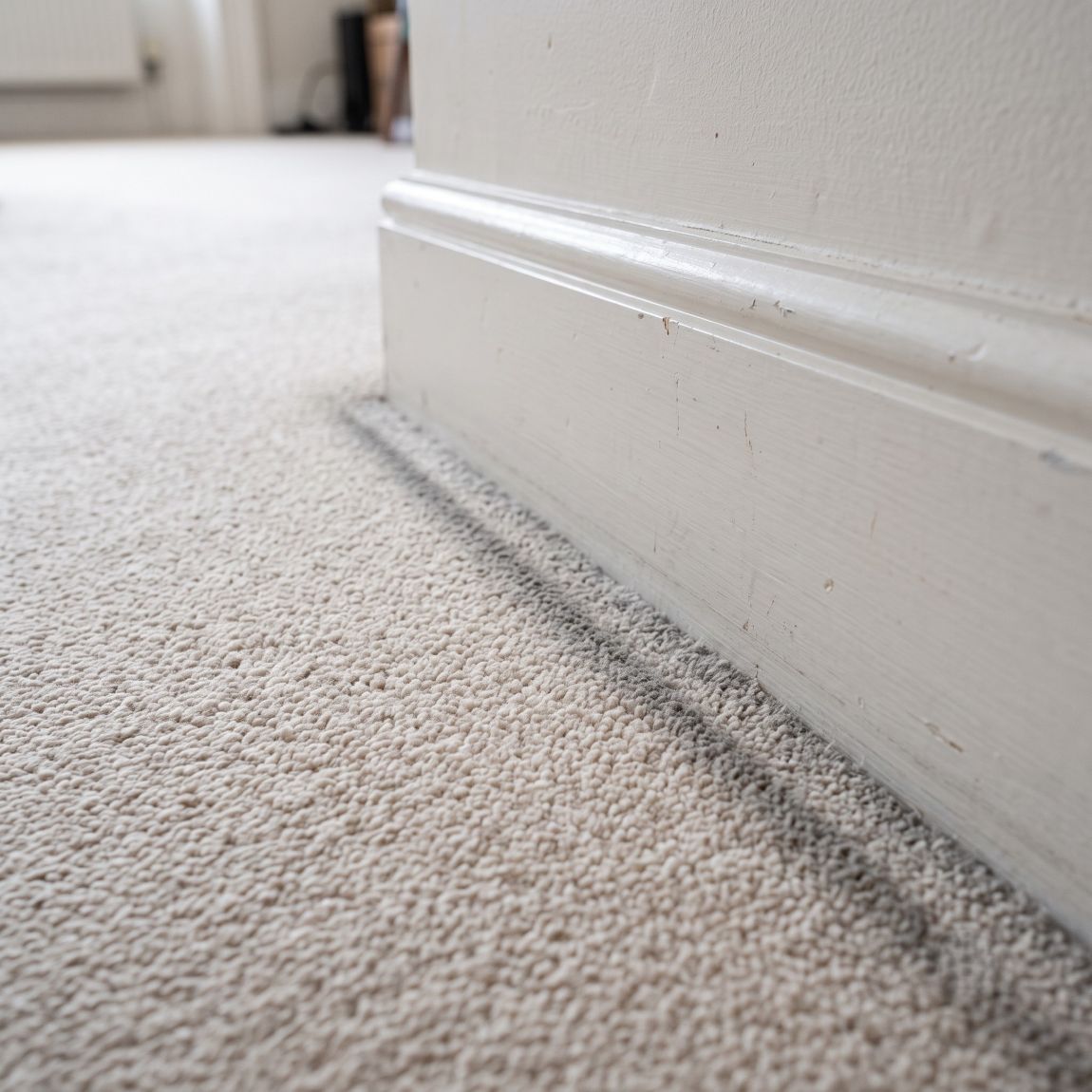
You spot it one afternoon when the light’s low: a dark grey line running along the bottom of the wall, hugging the skirting board, arrow-straight. It ducks under the door and picks up again on the other side. Your first thought is that the carpet cleaner missed a bit, or the dog’s been lying against the edge. So you get down on your knees with a cloth and a bit of spray, and you scrub – and the line doesn’t care. Same shade, same place, next week.
What is it, and why won’t it shift? It has a name – filtration soiling – and the short version is that you’re looking at your household air made visible. The carpet edge has been quietly filtering that air for months, and this line is what the filter caught.
Where do the black lines actually come from?
Air. Specifically, air being pushed through the carpet where it meets an edge.
Warm air and cold air are forever swapping places in a house – rising, sinking, sneaking under doors, slipping down into the gap between the floorboards and the skirting. Wherever that moving air has to squeeze through the carpet to get where it’s going, the pile does what any fibrous mat does to passing air: it filters it. The air goes through. The fine muck it’s carrying does not. It’s caught on the fibres, right at the edge, and it builds up – grain by microscopic grain – until months later there’s a visible grey band tracing the exact run of the skirting.
That last word is the giveaway. Exact. Filtration lines are dead straight and they follow the building rather than the foot traffic – tight against the skirting, in a clean stripe under every door, along the front lip of each stair. Dirt you tread in is blurry and random, heaviest where people actually walk. This is ruler-straight and heaviest where nobody walks at all, which is your first clue that it isn’t ordinary soil.
Why it lines up with the skirting board so precisely
The precision comes from the gap. In most homes, and nearly every Victorian terrace with a suspended timber floor, there’s a void under the boards and a small gap where the carpet edge meets the wall. Pressure differences between the warm room and that cold void – driven by the heating, by draughts, by the stack effect in a tall house – pull room air down through the carpet edge and into the gap, constantly. The carpet sitting over that gap becomes a permanent, unpaid air filter that nobody ever changes. Give it a few years and the result is simply inevitable.
The doorway is usually the worst of it, and for the same reason. A closed internal door forces all the air moving between two rooms through the one narrow slot underneath, and the carpet in that slot filters the lot. It’s why the line so often darkens as it approaches a door and fades a little in the open middle of the room, where the air isn’t being funnelled through anything.
What’s in the line – and why is it greasy rather than gritty?
Run a white cloth along it and you don’t come away with grit. You get a greasy grey-black smear. That texture is the whole story.
The particulate is fine – much of it sub-micron, far smaller than any dust you can see – and a lot of it is oily. Frying sends a fine aerosol of grease into the air every time. Candles, open fires and wood burners throw out soot. Outside, London air does the rest: diesel particulate off the traffic drifts in through every gap, and if you’re on a main road – the sort of terraced street where the buses idle at the lights – your indoor air carries a steady load of the stuff. Add skin cells, carpet fibres, the odd trace of printer toner, and you’ve a greasy sub-micron dust that bonds to fibre and won’t let go.
The oil is the reason it clings. Grease makes the soot stick, and it glues the whole deposit to the pile in a way dry dust never manages.
If it helps to picture it: the black stripe by your skirting is partly the same fine diesel soot the air-quality monitors on the main roads are there to measure. The carpet edge is doing a slower, dirtier version of the same job, and keeping the evidence.
The candle habit nobody wants to hear about
Here’s the part people push back on: scented candles are one of the worst offenders in a modern home, and the cheap paraffin ones are the worst of those. That three-wick you burn every evening through the winter is putting a fine soot into the room air for hours, and a good share of it ends up filtered straight into the carpet edge by the nearest door. People find this genuinely hard to swallow – the candle smells lovely, the room feels cosy, and the black stripe by the skirting seems like a separate matter entirely. It isn’t a separate matter. If your lines got noticeably worse over a winter of nightly candles, there’s your culprit, and no, you won’t enjoy hearing it.
Why won’t it just vacuum or scrub out?
Because none of the things you’d normally do to a carpet touch this kind of dirt.
Vacuuming glides straight over it. The particles are too fine and too firmly bonded for suction to lift – the vacuum takes the loose surface dust and leaves the soot welded to the fibre. So you reach for a spray and a cloth, and that’s where it gets worse, because your ordinary carpet spray is water-based and the deposit is grease-bound. Water-based cleaner on a greasy line does two unhelpful things at once: it smears the deposit sideways into the clean pile beside it, spreading the mark out into a grey haze, and it presses some of it deeper. You scrub, you get a bit of grey on the cloth, you feel like you’re winning – and what you’ve done is push the edge of the problem into carpet that was perfectly fine an hour ago.
Shifting it properly means a solvent to break the grease first, then agitation to work the freed particulate up out of the pile, then hot water extraction to flush it away before it can resettle. That’s a different job from lifting a spill, and it’s exactly why the line you’ve been going at with a household bottle has never once budged.
The honest bit about whether it fully comes out
I’ll be straight, since plenty of adverts won’t: a fresh filtration line, caught early, usually cleans up well. One that’s been building along a skirting board for eight years might never come out completely. The fine particulate can work so far down into the base of the pile and the backing that it becomes, in effect, part of the carpet’s colour. Any cleaner promising a guaranteed 100% result on a decade-old line is overselling you. A big improvement, yes. A flawless one, not always – and when it falls short, that’s the carpet, not the cleaner letting you down.
Which rooms and houses get it worst?
Some homes are practically built to grow these lines.
Rooms with candles, an open fire or a wood burner make the most soot, so they show it first – usually the lounge. Kitchens get the greasy cooking version. Any house with draughty suspended timber floors, which is half the Victorian and Edwardian stock in London, has the gaps and the underfloor void that drive the airflow in the first place. Forced-air heating or a boiler that’s overdue a service pushes more particulate around the rooms. And a house sitting on a busy road simply starts with dirtier air coming in.
The staircase that acts like a chimney
Tall, narrow London townhouses get a special version of this. A four-storey house with the staircase running up its spine behaves like a chimney – warm air rises up the stairwell and has to be replaced by air drawn in lower down, and that steady vertical current is pulled through the carpet at every stair edge and every landing skirting on the way up. It’s why filtration lines on staircases are so common and so stubborn: the airflow driving them barely stops. Look along the front edge of each tread. A dark line on every single one, lined up floor to floor, is the stack effect drawing its own diagram.
Can you get rid of it – and stop it coming back?
Two separate jobs, and the second one matters more than the first.
Removal is a professional degrease-and-extract, as above, with expectations set honestly by how long the line’s been sitting there. Prevention is where you actually win, and it comes down almost entirely to the source. Burn fewer candles, and better ones if you must have them. Use the extractor fan or crack a window when you fry. Get the boiler and any forced-air system serviced. A decent air purifier with a proper filter takes a real bite out of the airborne load in the room it’s standing in. And if you’re mid-renovation with the carpets lifted, sealing the gap along the skirting and floor edge closes off the very route the air takes through the pile.
You won’t stop it dead in a leaky Victorian terrace on a bus route. The air keeps moving and the gaps are still there, with the road right outside. But you can slow it from a line that’s obvious in three years to one that takes fifteen to show.
The one change that does the most
If you do nothing else, tackle the biggest soot source in the room. Nine times out of ten that’s the candles, and cutting the nightly ritual back to the occasional one does more for the skirting line than any amount of scrubbing ever will. Unglamorous and mildly annoying – and the single most effective thing on this entire list.