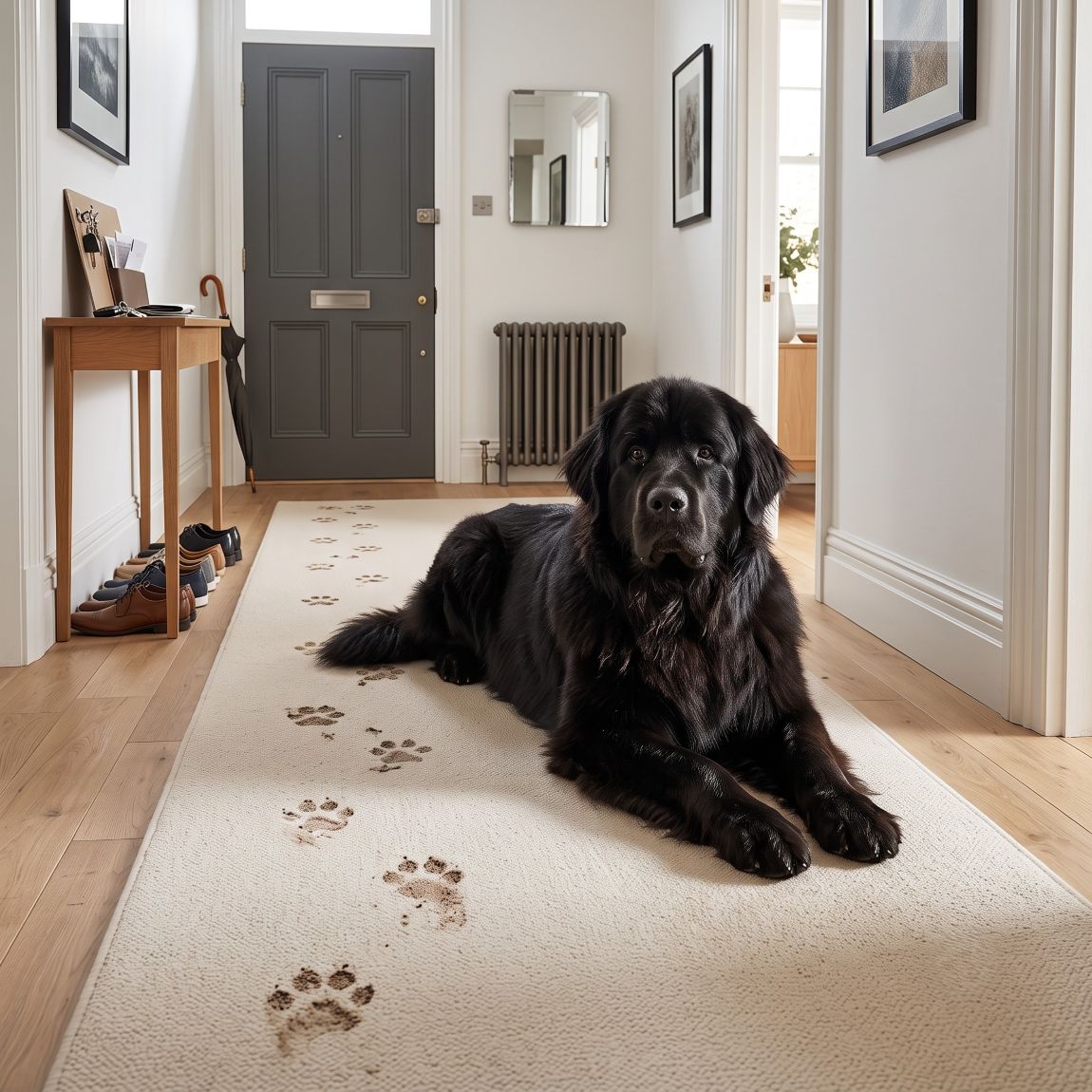
You open the door. The dog shakes – that full-body helicopter shake that flings water up the skirting – and before you’ve got one welly off, there’s a line of prints marching down the hall towards the kitchen. Some of them are already on the bottom stair. You know exactly what’s about to happen if you grab a wet cloth and start scrubbing, because you’ve done it before and made it worse.
So: can you actually get this out, or have you just written off the hallway carpet until spring? You can get it out. Almost always. The catch is that the thing your hands are itching to do right now is the one thing that turns a Tuesday-evening annoyance into a permanent brown ghost in the pile.
Why does London mud cling to hallway carpet so stubbornly?
Blame the ground under your feet. Most of the capital sits on London Clay, a fine, dense, faintly blue-grey stuff that turns to something like wet putty after rain. It isn’t sandy soil that brushes off when it dries. It’s sticky at a particle level, which is why the mud your spaniel drags back from Hampstead Heath behaves so differently from beach sand – it works its way between the fibres and holds on.
Carpet pile makes it worse. Each tuft is basically a tiny brush, and wet clay particles – the “fines” – lodge right down where the tuft meets the backing. Rub at the surface and you feel like you’re cleaning. You’re not. You’re pressing the fines deeper and spreading the edges of the mark outward.
That’s the whole problem in one sentence, really.
Wet mud versus dried mud – and why one is your friend
Here’s the counter-intuitive bit that most people get wrong in the heat of the moment. Dried mud comes out far more easily than wet mud. Wet clay smears; it bonds to the fibre and moves sideways under pressure. Dried clay goes crumbly and brittle, and a crumbly solid can be broken up and lifted away. The instinct to attack the mess the second it lands is, nine times out of ten, exactly backwards.
What should you do in the first sixty seconds after a wet walk?
Contain the dog. Genuinely, before anything else – a towel over the animal or a firm “wait” on the mat, because a second lap of the hallway doubles your work.
Then leave the mud alone.
I mean it. If there’s standing water or a proper wet slick, press a dry towel or a wad of kitchen roll straight down onto it – flat, no dragging – just to pull up the excess liquid. That’s the only intervention that’s safe while it’s wet. You’re lifting water, not cleaning mud. Once the visible wetness is gone, walk away and let the rest dry solid. An hour, two hours, overnight if it’s a real Heath-in-January situation. The carpet will look worse before it looks better. Trust it.
The one thing that turns a stain into a permanent one
Scrubbing wet mud. That’s it. That’s the mistake.
When you scrub wet clay, you drive the fines down into the base of the pile and out into a wider halo around the print, and no surface clean will ever reach them again – the dirt is now living below the level your cloth can touch. What looked like a tidy little paw shape becomes a vague brown smudge the size of a saucer, and it’s set. People do this constantly because doing something feels better than doing nothing, and then they ring round a week later.
How do you actually lift dried paw prints without spreading them?
This is the part that matters, so I’m going to slow right down.
Wait until every print is bone dry and crusty. Poke one – if it gives at all, it’s not ready. Once it’s properly dried, the mud has turned into a thin, brittle deposit sitting mostly on top of the fibres, and now you get to be a bit satisfyingly destructive. Break the crust up. Work a stiff brush, an old washing-up brush, or even the edge of a blunt knife across each print to fracture the dried clay into loose grit. You’ll see it turn to powder and dust. Good.
Now vacuum. Properly – go over it two or three times from different angles, because the loosened fines fall into the pile and a single pass won’t clear them. A surprising amount of the mark leaves at this stage. On a darker carpet, sometimes all of it does, and you’re done before you’ve touched a drop of water. Check before you go further, because the less liquid you introduce to a hallway carpet the better.
If a stain remains after vacuuming – and on a pale carpet it usually will, a faint tan outline where the clay stained the fibre – now you dampen. Not soak. Damp.
The blot-don’t-rub technique, step by step
Take a clean white cloth. White matters, so you can see the dirt transferring and so no dye lifts out of the cloth into your carpet. Wet it with cool water – cold or lukewarm, never hot, hot water sets protein and can felt wool – and wring it out until it’s barely moist.
Press it onto the stain and hold. Count to ten. You’re letting the moisture soften the clay bond, not wiping. Then lift straight up.
Look at the cloth. See the brown? That’s mud that’s now on the cloth instead of in your carpet. Refold to a clean face and repeat – press, hold, lift, always working from the outside edge of the mark inward so you’re shrinking the stain rather than smearing its border into clean pile. Change to a fresh part of the cloth every couple of presses. It’s slow. It’s meant to be slow.
The bit nobody tells you: know when to stop. If you keep wetting a hallway carpet you’ll saturate the backing, and then you get wicking – moisture travelling up through the fibres as it dries and carrying dissolved dirt back to the surface in a brown ring that reappears the next morning like a bad penny. Two or three damp passes, then let it dry. Come back tomorrow if there’s a whisper left.
Which cleaning solutions are safe, and which quietly wreck the pile?
For anything the water alone won’t shift, mix a few drops of plain washing-up liquid into a cup of cool water. A teaspoon, no more – too much detergent leaves a sticky residue that grabs fresh dirt for weeks afterwards. Same press-and-lift method, then a second pass with a clean damp cloth to rinse the soap out.
If a faint brown shadow lingers after everything else, white vinegar diluted about one part to four with water often lifts the last of it. Test it on a hidden corner first – inside a cupboard doorway, under the radiator.
Now the opinion you might not like: the supermarket “carpet stain remover” sprays are largely a waste of your money, and on the wrong carpet they’re a liability. Half of them over-wet the pile, some contain optical brighteners that leave a patch subtly paler than the carpet around it, and a few will happily bleach a wool blend while promising to be gentle. I’d rather you had washing-up liquid and a bit of patience than a fistful of trigger bottles from the corner Sainsbury’s. Never bleach, never undiluted anything, never hot water on wool.
Why wool hallway runners need different handling
Half the Victorian terraces in Walthamstow and Tooting have a wool or wool-blend runner down the hall and up the stairs, because that’s the period-correct thing and it looks lovely – right up until a labrador comes home from the common. Wool is a protein fibre. It hates heat, it hates alkaline cleaners, and it holds dye that some spot-treatments will strip. Treat a wool runner more gently than you think you need to. Cool water, mild soap, blot, and if you’re at all unsure, stop.
Can you stop the trail at the front door in the first place?
Not entirely. Anyone selling you a mud-free dog is lying. But you can knock the trail down to something manageable, and in a narrow London hallway – no porch, front door opening straight onto the runner, maybe a communal entrance if you’re in a flat – a bit of engineering at the threshold does most of the work.
The paw-wiping routine helps if you can train the dog to stand for it, which is its own battle.
The two-mat system that actually works in a narrow hall
One coarse scraper mat outside or immediately inside the door – rubber-backed, ridged, the kind that abrades the worst grit off the pads. Then a second, absorbent microfibre mat right behind it, the sort marketed for exactly this, long enough that the dog takes at least two full strides across it before reaching carpet. One mat cleans nothing; the dog clears it in a single bound. Two mats, sized properly, catch the grit on the first and the moisture on the second. It’s the single change that makes the biggest difference in a terraced hall, and it costs less than one professional clean.
When is it worth calling a carpet cleaner instead?
Some jobs have gone past the cloth. A set-in trail on a pale carpet that’s been walked over for days; a wool runner someone’s already attacked with the wrong spray; a mark you’ve cleaned three times that keeps coming back. That last one especially.
Professional hot-water extraction flushes water and solution deep into the pile and pulls it – along with the loosened dirt – straight back out under vacuum, which is the thing a cloth fundamentally cannot do. It reaches the fines living down at the backing, the ones your blotting never touched.
Signs the mark has wicked into the backing
Watch for this: you clean the stain, it vanishes while damp, you go to bed pleased – and by morning a soft brown ring has surfaced exactly where it was. That’s wicking. The dirt was never removed, only pushed down, and as the carpet dried it travelled back up the fibres to the surface. Once a mark is doing that, no amount of surface blotting will win, because you’re fighting something that lives underneath the part you can reach.